



What Size Dining Table Do You Need?

A dining table can look perfect in a photograph and still feel all wrong once it is in your home. Too wide, and the room feels pinched. Too narrow, and family meals turn into a balancing act. If you are wondering what size dining table you need, the answer starts with how you live as much as the tape measure in your hand.
The right table should do two jobs at once. It needs to sit comfortably in the room, and it needs to serve the people around it with ease. That means looking beyond a simple seat count and thinking about circulation, chair space, table shape and the way your home is actually used from one day to the next.
What size dining table works in your room?
The most useful place to begin is with the room itself. Before thinking about whether you want six seats or eight, measure the full dining area and then subtract the space needed to move around the table comfortably.
As a rule, you should allow at least 90cm between the edge of the table and the wall or any other furniture. If the space is a main walkway, 100 to 120cm is better. That extra clearance makes a real difference when chairs are pulled out, children are climbing in and out, or someone is carrying dishes from kitchen to table.
In practical terms, if your dining room is 3m wide, a table around 90 to 100cm wide is often a comfortable fit. In a larger room, you may have scope for a broader table, but bigger is not always better. An over-wide dining table can make conversation feel oddly distant and can leave serving dishes out of reach.
This is where made-to-order furniture becomes especially valuable. Homes are rarely built around standard furniture dimensions, and period properties, open-plan kitchens and family extensions all create their own quirks. A table crafted to suit the room often feels calmer and more considered than one chosen from a fixed size range.
Standard dining table sizes by seating
Seat numbers are a helpful guide, but they should never be the only guide. The amount of elbow room each person needs matters just as much. For comfortable dining, allow around 60cm of width per person. For a little more ease, especially if you enjoy longer dinners or generous place settings, 70cm per person can feel better.
A four-seater dining table is often around 120cm long and 75 to 90cm wide. This suits smaller dining rooms, kitchen diners and homes where the table is used daily but space is limited.
A six-seater is commonly around 150 to 180cm long. This is one of the most versatile sizes for family life because it offers enough room for everyday meals without dominating the room.
An eight-seater typically starts around 200cm in length, sometimes more depending on the leg design and whether you want generous spacing between seats. This size works beautifully in larger kitchens and dedicated dining rooms, particularly if you host often.
For ten to twelve people, you are usually looking at 240cm and beyond. At that scale, the room needs proper breathing space around the table or the whole effect can feel crowded rather than welcoming.
Width matters too. Most dining tables sit between 90 and 110cm wide. Around 90cm is practical for compact spaces and everyday family use. Between 95 and 100cm tends to give a pleasing balance between surface area and reach. Wider than 110cm can work well in grander rooms, though it is worth thinking about whether conversation and serving will still feel natural.
What size dining table for 4, 6 or 8?
This is the question most people ask, and rightly so. Yet there is a difference between how many people can fit at a table and how many can sit comfortably.
For four people, a rectangular table around 120 x 80cm is usually a reliable choice. A round table of 100 to 110cm diameter can also work very well, especially in a square room or a smaller kitchen where softer edges help movement.
For six people, look at a rectangular table around 160 to 180cm long and roughly 90cm wide. A round table for six is usually around 120 to 140cm diameter. If you like a more spacious setting, go slightly larger rather than trying to squeeze six onto a table intended for four most of the time.
For eight people, a rectangular table around 200 to 220cm long is often the sweet spot. A round table for eight generally needs to be at least 150cm in diameter, which can be beautiful in the right room but takes up more usable floor space than many people expect.
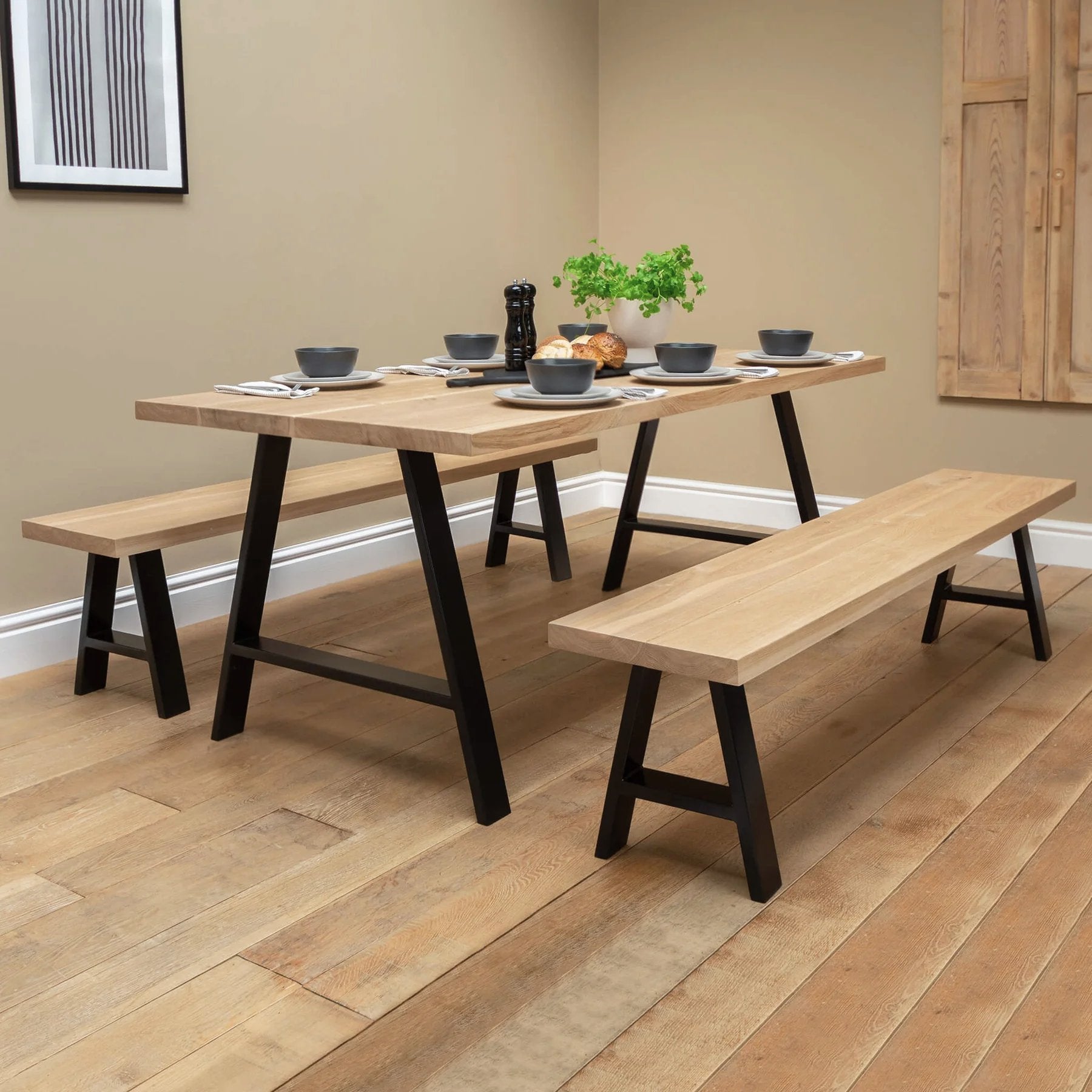
There is also the question of table legs and bases. Corner legs can reduce the usable seating space, especially if you are hoping to add an extra guest at the end. Pedestal or trestle designs can offer more flexibility, which is worth bearing in mind if your gatherings vary from week to week.
Choosing between rectangular, round and square tables
Shape changes how a table feels in a room just as much as size does. Rectangular tables are the most common because they make efficient use of space and suit the proportions of many British homes. They work particularly well in long rooms and open-plan kitchen dining areas.
Round dining tables bring a different quality. They soften the room, encourage conversation and remove the awkwardness of corners. They are a lovely choice for smaller gatherings and can make a compact room feel less rigid. The trade-off is that larger round tables need more overall floor space, and once you go beyond a certain size, they can become less practical to reach across.
Square tables suit square rooms and can feel nicely balanced for four people. Once you move beyond that, they become less adaptable unless the room is generous. In many homes, a square table that seats eight ends up feeling visually heavy.
If space is tight, bench seating on one or both sides can also help. It tucks neatly under the table when not in use and keeps the footprint a little tidier. That can be especially useful in kitchen diners where circulation matters throughout the day, not just at mealtimes.
The measurements people often forget
Table length and width get most of the attention, but there are smaller details that affect comfort every bit as much.
Dining table height is usually around 75 to 78cm. This works with most dining chairs, but if you are pairing a handmade table with existing seating, it is worth checking the chair seat height and the clearance beneath the apron or frame.
You should also consider what else shares the room. Radiators, sideboards, doors that open inward, and pendant lighting all affect where a table can sensibly sit. A table might fit on paper and still create a pinch point beside a cupboard or block the natural route through the room.
Then there is daily life. A household with young children may want a little more room between chairs. Someone who works from the dining table during the week may value extra depth. A couple who host Christmas but eat alone most evenings may be better served by an extending table or a bespoke size that sits neatly between standard options.
When bespoke sizing makes sense
There is no prize for forcing your home around an off-the-shelf table. If your room is awkward, if you need a narrower width, or if you want to seat more people without overwhelming the space, bespoke dimensions can be the difference between something that merely fits and something that feels right.
That is often where solid wood furniture comes into its own. A handcrafted oak table can be made to suit the real dimensions of your room and the way your family gathers around it. At Willen Rose, that practical side of craftsmanship matters just as much as the finish of the timber. The aim is not simply to make a beautiful table, but to make one that earns its place at the centre of the home.
If you are unsure, mark the table footprint on the floor with masking tape and pull out dining chairs around it. Walk past. Open doors. Imagine serving Sunday lunch or helping with homework at the same table. Those simple tests tell you far more than a product label ever will.
A well-sized dining table does not shout for attention. It simply feels settled, generous and easy to live with, ready for ordinary weekday meals and the bigger moments that become family memories over time.